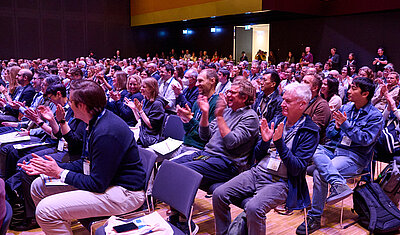
The Conference Program at a Glance
More than 300 presentations, workshops, tutorials, and meetups explored technical communication from many perspectives. Topics included AI and information modeling, content strategy and terminology management, user experience (UX), service documentation, and legal requirements. This year, many sessions examined how new technologies and regulations affect the day-to-day work of technical writing teams.
Artificial Intelligence: From Experiment to Responsible Use
AI was one of the defining topics of the tcworld conference. Kees van Mansom and Sadhana Suresh explained how AI agents will take on specific tasks and work together. Van Mansom described a set of specialized agents: An orchestration agent coordinates analysis, writing, review, translation, and training, among other tasks. Using documentation for application programming interfaces as an example, Suresh showed how AI agents bring scattered content together and support its creation and quality assurance. Both speakers described how AI is evolving from a single tool into a connected team of specialized assistants.
Many presentations discussed how to integrate AI into editorial processes and what this requires. According to the speakers, good results do not depend on powerful models alone. The quality of the data, a clear information structure, and the knowledge that AI systems draw on matter just as much.
Other speakers explored how AI agents can be integrated into existing documentation processes. Topics included knowledge graphs, semantic models, and Model Context Protocol (MCP) servers. MCP is an open standard that lets AI systems access data sources and tools. Another topic was delivering information to both humans and machines.
Translation and terminology were also well represented in the program. Sessions covered AI-assisted translation and quality assurance, the use of locally hosted large language models, and terminology as the basis for reliable AI output.
DPP: Connecting Product Knowledge and Putting It to Use
The DPP was again a central topic of the conference. Last year, attendees mainly discussed its fundamental importance and upcoming requirements. In 2026, thediscussion moved toward concrete implementation and the data structures it requires.
Prof. Dr. Thomas Knothe’s keynote „The Digital Product Passport: The (Not Yet) Perfect Game Changer“ set the tone. He outlined the significant opportunities the DPP offers but also named many open questions. Knothe explained how the DPP works, whom the regulations affect, and which standards companies must meet. He described where implementation is still stalling and which challenges companies face. Drawing on practical experience, he discussed opportunities and risks, common mistakes, and technical tools that have proven effective—or have not. His message: Companies that want to implement the DPP successfully should prepare early and learn from the experiences of others.
Other presentations addressed the regulatory framework and current developments. Franziska Zibold spoke on „Regulatory Framework, Most Recent Developments and Future of DPP“.
For tekom Deutschland, this is a clear mandate: After the FokusTag DPP in June 2026, the topic will stay on the agenda in 2027. The association plans to keep supporting its members with in-depth information and practical assistance on their way to the DPP. At the tekom fair, exhibitors took up the topic on Wednesday on the Application Stage.
Law and Standards: Machinery Regulation and Cyber Resilience Act
Legal and normative requirements for technical communication formed another major topic area. Attendees were particularly concerned with the new Machinery Regulation and the CRA. Both regulations change the requirements for product information and documentation. Companies need to adapt their processes early.
Jens-Uwe Heuer-James dedicated his presentation „Machinery Regulation“ to Machinery Regulation (EU) 2023/1230, which applies from January 2027. He explained the new requirements for manufacturers of machinery and related products. One point is particularly relevant to technical communication: Under certain conditions, manufacturers may provide instructions for use in digital form. The requirements for accessibility, downloading, saving, and printing show that digital documentation is an organizational and legal task as well as a technical one.
The CRA also had a prominent place in the program. Susanna Akdut gave a practice-oriented presentation titled „From Hack to Hazard: Instructions for Use in the World of CRA and Machinery Regulation“. She connected both regulations and explained how they affect instructions for use and safety information.
The presentations showed that technical documentation is increasingly part of product compliance. Information on safety, intended use, and digital product features must be understandable, complete, traceable, and compliant.
Information Architecture, Terminology, and Information Delivery
Beyond AI and legal topics, many sessions dealt with the foundations of future-ready information delivery. How must content be structured so that people and machines can find and process it? What role do metadata, ontologies, and knowledge graphs play? And how can companies use their existing knowledge across different systems?
Speakers presented different ways to connect information and break down silos. These included practical examples of iiRDS, the standard for exchanging technical documentation, as well as structured content, semantic models, and intelligent solutions for information delivery. Speakers also discussed whether metadata is still necessary in the age of AI.
Rutva Safi’s presentation „Writing for Humans vs Writing for AI“ offered practical guidance. She explained how to optimize technical content for both people and AI systems. For quality assurance after every release, she recommended four steps: classify, review, correct, and retest.
Terminology management also played an important role. Sessions described the path from traditional dictionaries to terminology hubs, the cleanup of product names, and company-wide terminology strategies. They underlined how important consistent technical language is for quality, translation, and AI applications.
UX, Visual Communication, and Service Documentation
The user-centered design of technical information was another topic. In the UX track, speakers discussed how to make content easier to understand and better suited to specific usage situations.
Other sessions covered user journeys, usability tests, and how to deliver technical information effectively across different media. In visual communication, the program included the reuse of computer-aided design data as well as 3D animations and digital twins.
Speakers also looked at service documentation in light of new technologies. How can service knowledge and technical documentation be brought together? How can AI and intelligent information delivery support maintenance, troubleshooting, and repair? Practical examples of connected service information and digital platforms showed that well-prepared product knowledge is gaining importance across the entire product lifecycle.
New Perspectives on Careers and Collaboration
Finally, the program turned to the people who shape change in technical communication. What skills will technical writers need in the future? How are AI and automation changing roles within teams? And what new tasks lie ahead for managers?
Sessions on leadership, career development, young professionals, and new job profiles showed that technical expertise remains an important foundation. Skills in data management, AI, strategy, and collaboration are becoming just as relevant. The role of people in AI-supported work processes was a common thread across many conference topics.
Between presentations and workshops, attendees used the networking breaks, the Café tekom, and the lounges to discuss what they had heard and to expand their networks. In personal conversations, they added experience from their own companies to the knowledge gained in the conference program.
Since 58 selected presentations in the form of screencasts (audio track with presentation slides) from Plenary 1, Plenary 2, and Room C5.2/3 are still available for viewing and downloading after the conference, attendees on site did not have to constantly decide which sessions they could attend and which they would have to miss.
Missed the entire conference? Then you can still purchase a recording ticket afterwards. Access to presentation slides for all remaining contributions is included. Access to all recordings is available until February 21, 2027.


Images: Roman Hermann