


Visitor magnet tekom fair 2026
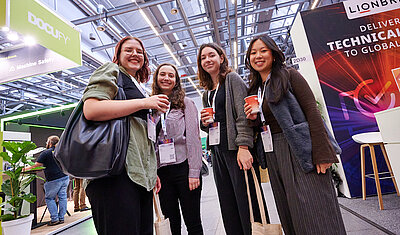
Since 2025, the tekom fair has had a more compact layout. But less space does not mean a smaller fair: The number of exhibitors keeps growing. In 2026, nearly 100 companies exhibited, more than in the previous year. For attendees, this meant short distances and more time for conversations at the booths.
Exhibitors presented products, services, and technologies for technical communication. The offerings included authoring and content management systems, terminology and translation solutions, solutions for information delivery and knowledge management, and AI applications. At the booths, attendees discovered new solutions, asked providers their questions directly, and compared different approaches. Two stages complemented the exhibition: the Application Stage and the Solution Stage.
tekom Insights: A Look at the Association and Its Community
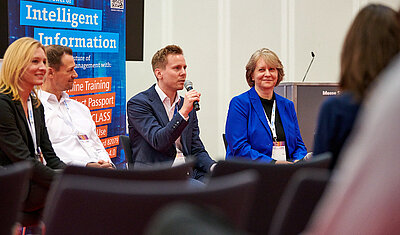
On Tuesday morning, the association and its community opened the Application Stage program with their own segment: tekom Insights. tekom Deutschland and tekom Europe presented their work, their offerings, and current developments. The Young Professionals Advisory Board and the Education and Training Advisory Board also contributed. Topics included ways to get involved with tekom Deutschland and its services, the future of the international community, and new formats for knowledge transfer. Speakers also discussed which skills universities, teams, and the profession will need in the future.
To close the segment, the iiRDS consortium examined how widely the standard has already been adopted in practice. Attendees gained insight into the association’s work and the diversity of its community.
Application Stage: From AI Readiness to the Digital Product Pass (DPP)
Beyond tekom Insights, the Application Stage featured specific use cases and solutions on all three days, each day with its own theme. On Tuesday from 1:00 p.m., the theme was AI Readiness. Presentations covered data-sovereign, AI-assisted translation processes, among other topics. A live demo compared retrieval-augmented generation (AI answers based on a company’s own knowledge sources) with agent-based chatbots. Other presentations showed how to integrate AI into existing systems and editorial workflows and how to turn documentation into AI-ready content.
Wednesday was dedicated to the DPP. Exhibitors showed how product data can be connected and used for the DPP. They also explained how knowledge platforms bring existing product knowledge together and make it available for service, AI, and other applications. On Thursday, the stage belonged entirely to World Usability Day.
World Usability Day (WUD): UX and Accessibility
WUD Stuttgart took over the Application Stage for all of Thursday. It was held as part of the tcworld conference and tekom fair for the second time. Sessions addressed UX, digital accessibility, and how to make digital products understandable and accessible to as many people as possible. Presentations covered the role of AI in digital ethics, accessibility, new forms of collaboration, and human-centered design. Their shared message: AI can support the development and design of digital products, but it does not replace engaging with the needs and abilities of users.
WUD brought additional input from UX and design into technical communication and encouraged exchange with neighboring disciplines.
Solution Stage: Solutions for Everyday Practice
The Solution Stage ran parallel to the Application Stage on all three days. Exhibitors had 20 minutes each to present their tools, products, and services and gave insight into specific applications for technical communication. Presentations covered variant and variable management, AI-powered language and translation technologies, terminology platforms, and connected product knowledge. Solutions for information delivery, XML documentation, and digitizing expert knowledge were also on stage. Other presentations dealt with compliance documentation for information security, video documentation, risk assessment, and spare parts catalogs.
The short format made it easy to get started and compare different approaches. Afterward, interested attendees talked directly with the providers to learn more about possible applications.
OpenLab – Unconference: Exchange Among Peers
On all three days, the OpenLab – Unconference offered space for conversations and discussions beyond the classic presentation format. Anyone who wanted to propose a topic wrote it on a sticky note and assigned it to a time slot on the Unconference board.
In this open format, attendees raised their own questions, shared experiences, and exchanged ideas with other experts. Especially on AI, new ways of working, and legal requirements, they brought in questions from their daily work and developed ideas together.
universityHUB and Young Professionals
The tekom fair also made room for the next generation and for networking with universities. The universityHUB and the job wall served as contact points for students, graduates, career starters, and companies. There, attendees learned about degree programs, continuing education, and career prospects in technical communication.
The Young Professionals Advisory Board added its own offerings. On the Guided Tour, attendees explored the fair together and visited key stops. First-time attendees in particular gained an overview of exhibitors, association offerings, and topic areas.


Images: Roman Hermann